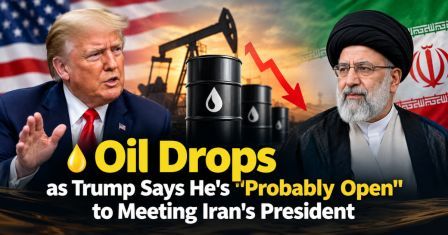
Oil Drops as Trump Says He’s “Probably Open” to Meeting Iran’s President
Oil is having its worst stretch in weeks, and it isn’t because of new supply. It’s because a war that has kept crude above $100 for months might, for the first time, have an off-ramp.
On Monday, Brent crude fell about 2% to roughly $101.70 a barrel, while WTI dropped more sharply, sliding to around $95.80-$98.30 depending on the reading. That’s four consecutive losing sessions, oil’s longest slide since a ceasefire memorandum collapsed back in the summer. One tracker put the move at an 11-day low.
The trigger was simple: on Sunday, President Trump told Fox News he’d “probably” be open to meeting Iranian President Masoud Pezeshkian on the sidelines of the UN General Assembly, which runs September 22 to 26 in New York. He also decided against striking Iran-backed Houthi forces in Yemen for now, despite pressure from Saudi Arabia to do so.
It’s worth being careful here. Trump’s own framing of his options wasn’t exactly conciliatory. He described the choices as “wiping Iran out,” letting its economy “rot,” or reaching a deal, and said he was in “deciding mode.” Iran’s military, meanwhile, warned that any new US strike would trigger “painful” retaliation across the region.
Still, markets read the meeting offer as the most direct diplomatic opening in months, precisely because it came from Trump personally rather than through intermediaries. Qatar’s prime minister confirmed that Washington and Tehran are exchanging messages. Iran’s side, relayed through Qatari mediators, reportedly wants sanctions relief and an end to the naval blockade before any presidential handshake, not just a ceasefire.
There’s also a practical reason both sides may want an exit. Diesel prices in the US hit a national average of $6.505 a gallon last week, and that kind of pump pain is a real liability for Trump’s party ahead of the November 3 midterms. On the Iranian side, the economy has reportedly contracted sharply since the war began.
None of this means the war is over. A similar diplomatic opening in early September produced a one-day price drop that mostly reversed within 72 hours. Brent at $101.67 is still far above pre-conflict levels, even if it’s down from April’s peak near $125.
What happens next probably depends on whether Trump and Pezeshkian actually meet this week, and whether Iran’s public UN address on September 24 signals compromise or defiance.
Sources: CNBC (cnbc.com), The National (thenationalnews.com), Eastern Herald (easternherald.com), HNGN (hngn.com), Pomegra News (pomegra.io)