
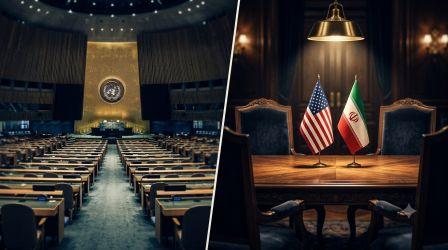
Trump Threatened to “Annihilate” Iran at the UN. Hours Later, His Team Sat Down With Them Anyway.
Tuesday gave the clearest look yet at how Trump is running the endgame of the Iran war: maximum rhetoric in public, quiet contact in private, often within the same news cycle.
In his address to the UN General Assembly, Trump framed the seven-month conflict, which began in February, as a binary choice. “Will a deal be made with Iran that lets them rebuild and create a far greater country than it ever was before… or do I annihilate the Islamic Republic and do it quickly, never giving them a chance to kill and destroy people and countries again?” he asked. “Do I drive them into hell?” As he spoke about Iran’s military conduct over the past six months, Iranian delegates walked out of the hall. Iran’s President Masoud Pezeshkian and Foreign Minister Abbas Araghchi were in New York for the Assembly but skipped the speech entirely.
Then came the twist. Later that day, Trump told reporters that American and Iranian officials had spent three hours together on the sidelines of the summit, the first confirmed direct contact between the two sides since the war started. He called it “a very good meeting,” though he was careful to clarify who was actually in the room: his envoys Steve Witkoff and Jared Kushner sat with Iranian intermediaries, not top Iranian officials themselves. “Not the highest level, but it’s something,” he said.
His envoy Steve Witkoff put it more formally in a social media post, saying the US and Iran had engaged in lengthy talks through mediators who shuttled between the two sides throughout the day.
Iran’s public posture stayed defiant. Mohammad Bagher Ghalibaf, speaker of Iran’s parliament and one of its top negotiators, said before Trump’s speech that the president “can’t impose his power on Iran.” Trump, for his part, kept returning to the binary. “It’s a greatness, potential greatness or obliteration,” he told reporters. “In one case, it’s obliteration. And the other alternative is potential greatness.”
There’s a domestic timing angle too: Trump indicated a deal is realistically more likely to land after November’s US midterm elections, not before, which suggests neither side expects a breakthrough this week even if talks continue.
The rest of Trump’s UN speech touched several other flashpoints in the same session, including a new US-Denmark-Greenland security pact, a pledge to grow US munitions stockpiles, and a vow that Cuba’s government “will fall,” which prompted Cuba’s delegation to walk out as well. Separately, he met Ukraine’s Volodymyr Zelensky, who described the talks as “positive and productive” and said he’s open to a three-way meeting with Russia and the US, including discussion of a possible energy-infrastructure ceasefire.
What to watch next: Iran addresses the General Assembly on September 24, and Israeli Prime Minister Benjamin Netanyahu speaks the same week. Whether Tehran’s public tone matches what its intermediaries said behind closed doors will say a lot about whether Tuesday’s meeting was a real opening or just theater.
Sources: CNN (cnn.com), Newsweek (newsweek.com), ABC News (abcnews.com), Time News (time.news)